|
Nanxi River, a key scenic resort of the State is adjacent to Yandang
Mountain Scenic Resort, and is at a distance of 23 km away from the city
area of Wenzhou. Nanxi River's divided into seven scenic areas,
covering more than 800 scenic landscapes. With its main stream
extending 139.8 kilometers long, Nanxi River possesses 36 bays and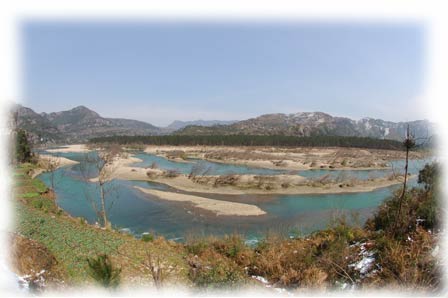 72 shoals, characteristic of an exciting panorama of pure water, crags
of grotesque shapes and sizes, splashing waterfalls, hidden ancient
villages and intriguingly beautiful beach forests.
72 shoals, characteristic of an exciting panorama of pure water, crags
of grotesque shapes and sizes, splashing waterfalls, hidden ancient
villages and intriguingly beautiful beach forests.
Nanxi
River basin is proud of distinctive cultural features as well as rich
cultural heritage. In the Neolithic Age as early as 5000 years ago, the
forefathers of Ou and Yue (respectively representing Wenzhou and eastern
Zhejiang) people have labored, lived and multiplied on this land, and
have cultivated Ou and Yue culture. Up to now, there still retain in
this place many cultural relics of Neolithic Age as well as a string of
historic and cultural sites as ancient towers, ancient bridges, ancient
pavilion and ancient archway buildings, etc, of Song, Ming and Qing
Dynasty. The ancient villages and buildings in the banks of Nanxi River
are characteristic of carefully selected location, rigorous planning and simple and sophisticated style, greatly harmonizing with
natural surroundings, being one of the four popular traditional civil
residences in China. The prominently are the villages as Yantou, Fenlin,
Cangpo, Furong and Huatan, etc. and they are the historic and culture
reserves of Zheiiang Province.
planning and simple and sophisticated style, greatly harmonizing with
natural surroundings, being one of the four popular traditional civil
residences in China. The prominently are the villages as Yantou, Fenlin,
Cangpo, Furong and Huatan, etc. and they are the historic and culture
reserves of Zheiiang Province.
The
remarkable land has given birth to numerous outstanding people and
created glorious culture. From Tang Dynasty to Qing Dynasty, total 604
Jinshi (a successful candidate in highest imperial examination) coming
from Yongjia County. During the Northern Song and Southern Song
Dynasty, the glorious "Yongjia School of Thought" and "Four Famous
Scholars of Yongjia" held a prominent position in the cultural history
of China. In 2001, the Kun Opera of China was conferred the title
"Masterpiece of Dictated and Non-Substance Legacy of Mankind" by the
United Nations, and the Kun Opera of Yongjia, as an important embodiment
of Kun Opera Culture, has become a common spiritual wealth of the whole
mankind. Besides, there are numerous life traces, voluminous poems and
literal works of notables left in Naiixi River region. The historically
significant and literally reputed personages such as Wang Xizhi, Yan
Yanzhi and Xie Lingyun were
 ever
the local magistrates of Yongjia. Tao Hongjing in Southern Dynasty,
Zhang Zirong and Meng Haoran in Tang Dynasty, Lu You, Ye Shi and Xu Zhao
in Song Dynasty, Wang Shuguo and Pan Shunchen in Ming Dynasty. Zhu
Yizun, Jin Jianan and Zhu Buxi in Qing Dynasty all had traveled to Nanxi
River, and had left many popular and influential literal works. Xie
Lingyun, who was the originator of school of scenic poem of China,
during his office as the local magistrate of Yongjia, had traveled round
the waters and mountains of Yongjia and written a lot of popular and
prestigious scenic poems that handed down from generation to
generation. This makes Nanxi River the cradle of scenic poem and a holy
place in which men of letters generation after generation come to be
inspired. Because of ever
the local magistrates of Yongjia. Tao Hongjing in Southern Dynasty,
Zhang Zirong and Meng Haoran in Tang Dynasty, Lu You, Ye Shi and Xu Zhao
in Song Dynasty, Wang Shuguo and Pan Shunchen in Ming Dynasty. Zhu
Yizun, Jin Jianan and Zhu Buxi in Qing Dynasty all had traveled to Nanxi
River, and had left many popular and influential literal works. Xie
Lingyun, who was the originator of school of scenic poem of China,
during his office as the local magistrate of Yongjia, had traveled round
the waters and mountains of Yongjia and written a lot of popular and
prestigious scenic poems that handed down from generation to
generation. This makes Nanxi River the cradle of scenic poem and a holy
place in which men of letters generation after generation come to be
inspired. Because of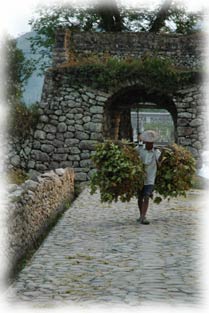 her special charm, China Writers' Association and China Photographers'
Association name Nanxi River respectively as "Base for Nationwide
Literature and Arts Creation and Photographic Creation Base".
her special charm, China Writers' Association and China Photographers'
Association name Nanxi River respectively as "Base for Nationwide
Literature and Arts Creation and Photographic Creation Base".
In
the meantime, Nanxi River area is a revolutionary base, the source of
the No. 13 Army of the Red Army as well as the center of revolutionary
activities in southern Zhejiang Province. The former site of No. 13
Army of Red Army has been established as a key historic relics
conservation unit and a base for patriotism education. Nanxi River
Scenic Resort is a high degree integration of scenic culture and ancient
village culture, an intermingling between labor and education culture
and clan culture, and an excellent agreement between human life and
natural environment. Just like an outsized art treasure, it is born a
perfect land, deeply loved and infatuated by innumerable tourists
domestic and abroad.
.pdf - 2,94 MB |
click on the newspaper cover to get a story from
Zhejiang's Intouch magazine
about "Sticks & stones" - Nanxi River and
beyond
July 2006 / www.intouchzj.com |
|
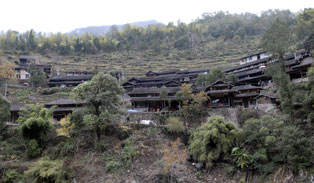
Lingshang Mountain Village
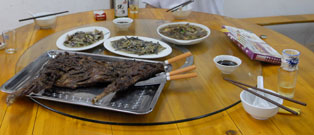
barbeque sheep meat |
The LINGSHANG households
LINGSHANG is a natural village that is administrated by the
LUOCHUAN Administrative Village. It is recorded in the JIN
Family’s Genealogy of LUOCHUAN that early in the JIAJING era of
MING dynasty; some people moved and started making a living
there and it has been more than 400 years history. Now, there
are in total 47 famillies, which are 193 people live in the
LINGSHANG natural village.
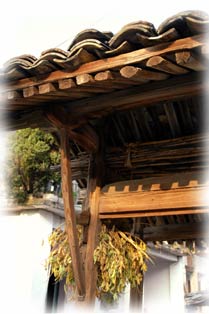
The LINGSHANG households back on mountains and face brook. Because
of the surrounded green mountains and being richly endowed by
nature, the air there is particularly fresh and thus it got the
name of “Natural Oxygen Bar”. The external appearance of houses
in village looks still old but simple and decent. However, the
internal of houses is exquisitely reconstructed like tearoom and
guestroom and they are exactly the place for one to have tea,
relax and enjoy the “Fun of Farmhouse” through its
special-flavored wines and dishes.
|
 click
on the namecard to get the address of the mountain
village and visit them in Nanxi River area. You also can
visit their homepage
www.lsrj.cn click
on the namecard to get the address of the mountain
village and visit them in Nanxi River area. You also can
visit their homepage
www.lsrj.cn |
|
|

|
click on Info to get a report about
"The Human Village" in Nanxi River
Basin |
|








 detailed forecast