|
By Zhu Guangyu, January 24, 2002
The historical traditions and clan stories are lived out in
the ancient villages of the Nanxi River Basin. But we may be the last
generation to see their way of life.
The reputation of Zhejiang provincial capital Wenzhou for being
China's entrepreneurial center gives credence to the myth that there is
little of tourism or cultural value in the region. But in the county of
Yongjia, in the southeast corner of the province, villages sit
undisturbed by modern development. Clear streams are lined with ancient
cypresses, and run along deep valleys that shelter humble thatched homes.
The Nanxi River carries the water that drains away from the Kuocang
and Yandang mountain chains. People have been living along its banks for
thousands of years, and villages measure their histories in thousands
rather than hundreds of years. The newest village, Tanxia (established
1279 A.D.) seems like positively modern settlement when compared with
the oldest in the region, Cangpo, the site of a village since 955 A.D.
Along the Nanxi River Basin, the noise of the modern city that
infringes many areas of beauty in developed eastern China does not
intrude. In recent years, thanks to local tourism development projects,
increasing numbers of people have started to arrive in the region, to
explore the lives and environments of local residents.
Clan Culture
Local architecture of the Nanxi River Basin region is distinctive
from its nearest neighbor, the Jiangnan (southern Yangtze River). The
overriding principle here is one of nurturing the beauty of the country
scene, making the most of the green hills and clear water. The aesthetic
sensibilities of the upper classes, built on former feudalistic
principles, still prevail in the village and dwelling layouts.
Along the middle reaches of the Nanxi River lie around 200 villages,
all with blood-ties, where people of a single family name live. Each
village is a community in and of itself, based on patriarchal clan
principles. The system oversees every aspect of village life, and
maintains social order and self-sufficiency.
The origins of local culture are rooted in the migration of people
from the north to the south. The first time happened at around A.D.317
from the north of Yangtze River to the south of Yangtze River. With the
people traveled skills and talents, bringing much-needed development
opportunities to the area. While the villages lived self-sufficiently,
the names of outstanding citizens were still known further a-field, and
its number include Dongjin-era literature and calligraphy master Wang
Xizhi, poet and author Yan Yanzhi (A.D.384-546, era of Nan Dynasty), and
Xie Lingyun, the first landscape poet in China (A.D. 385-433, ear of Nan
Dynasty). As the cultural and literary representatives of their day,
along with administrative duties in their villages they also stimulated
a boom in the literature of the Nanxi River Basin. The descendents of
Xie Lingyun later established Heyang Village, which later still
separated out into 20 villages all carrying the family name of Xie.
The second wave of migration into the area arrived with the Song
Family (A.D.1127), as they traveled across the river, heading south.
Again, the sudden influx of art and literature stimulated another
cultural renaissance, and poets and scholars including Zhang Jiucheng,
Wang Shipeng, and Yang Jian arrived. The locals also had their share of
imperial recognition: between the Tang and Qing Dynasties (618-1911) a
total of 604 jin shi (successful candidates in the imperial
examinations) hailed from Yongjia County. Self-cultivation was to be
encouraged in the region, and historical records from the two waves of
migration suggest that it was not economic reasons, but for the
aesthetic side of rural life, that led people to settle along the Basin.
In the following Dynasties after the Southern Song, the prosperity of
the Southern Song Dynasty already waning, small families had been
replaced by large clans. Transportation around the mountainous region
was insufficient to allow for frequent travel, and the clan societies
closed, slowing the inflow of residents to a virtual standstill. As
such, most of the present day families can trace their genealogy to
those Song Dynasty days.
The architecture, unsurprisingly, also reflects the Song Dynasty
preferences for simplicity, with graceful and free lines. From the
outside, the houses present shapes of "一" , "H", "口", and "日". The
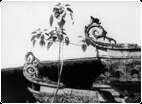
two-story houses are symmetrical, and the ridge of a roof is in the
shape of a bow, with the eaves turned up slightly. The overall shape is
one of being stretched out, and unrestrained.
Lying among the southern mountains of Zhejiang, Yongjia is abundantly
supplied with local stone, which is used in walls and streets, as well
as ornamental sculptures. Brick and wooden sculptures also decorate the
area.
Village layouts are clearly and strictly planned, with tidy village
walls and good use of flowing water supplies contributing to excellent
feng shui. The sites of villages were chosen for the views villagers
would be afforded as much as the proximity to water supplies: the shapes
of bordering mountain ranges were preferred be bijia shan (笔架山) - a
landscape of five mountain peaks in a tidy line, just like a rack of
calligraphy brushes. The village of Cangpo is blessed with bijia shan,
while Yantou and Penglai villages must make do with mere wenbi shan
(文笔山) skylines - a single calligraphy brush mountain.
In the modern day, preservation and environmental protection in the
area comes largely from the clan heads themselves. Without doubt, Cangpo
and Furong villages are the most carefully preserved in the area. Cangpo,
with its ancient village gate, temple, halls, and pavilions, is home to
some of the most exquisite examples of ancient relics: the Shuiyue Tang
(Water and Moon Hall) was erected in the 9th Century in memory of the
8th Century ancestor Li Jinxi, a jin shi of the Northern Song Dynasty
who sacrificed himself on the battlefield. Also still standing is the
Renji Temple, built in 1180 and surrounded on three sides by water and
cypress. Nowadays, it is home to a folk art museum that is open to the
public.
With the impact of the developing modern market economy happening so
close, China's countryside is changing rapidly. The villages of the
Nanxi River Basin have not escaped progress, and many of the villagers'
houses have been cleared to make way for newer buildings. With
responsibility for the upkeep of the houses left in clan leaders hands,
some of the finest examples of the architecture of the Song Dynasty is
gradually rotting away, or being destroyed in fire. Sadly, the question
must be asked: are we to be the last generation to be eyewitnesses of
such relics of this traditional culture?
[top] |










 detailed forecast